How Whisky Is Made | The Complete Whisky Production Guide
Fermented grain, distilled, then left to rest in wooden casks for years. At its most basic, whisky really is that simple. What makes it endlessly complex is how each step changes the final spirit: the grain, the malt, the fermentation, the still, and the cask.
From Grain to Glass
A Step-by-Step Guide to the Whisky Production Process
Whisky is one of the world’s most complex
spirits, but the fundamentals of how whisky is made are surprisingly simple.
Across Scotland, Ireland, the United States, Japan and Denmark, the same core
principles apply.
At its heart, whisky production follows a
sequence of steps:
- 1. Grain selection
- 2. Malting and milling
- 3. Mashing
- 4. Fermentation
- 5. Distillation
- 6. Maturation in oak casks
- 7. Blending and bottling
Each stage shapes the character of the
final whisky. Small variations in ingredients, fermentation time, still design
or cask selection can dramatically change flavour.
This guide explains the full whisky-making
process from grain to glass. an in depth explanation of the finer details in distilling can be found here.
The Core Ingredients of Whisky
Although whisky styles differ around the
world, most whiskies are made from just three essential ingredients
- Grain | Provides starch that is converted into fermentable sugar
- Water | Used during mashing and fermentation
- Yeast | Converts sugar into alcohol during fermentation
The choice of grain is one of the main
factors that distinguishes different whisky traditions.
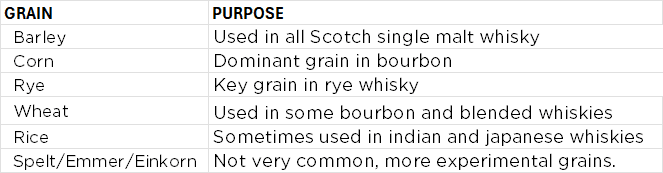
Some whiskies use a single grain, while
others use a blend of several grains, known as a mash bill.
Step 1: Malting the Grain
For many whiskies, the process begins with
malting, especially when barley is used.
Malting prepares the grain so its starch
can be converted into sugar. The process involves three stages:
Steeping – The grain is soaked in water for
around two days. This raises the moisture content and activates the grain’s
natural enzymes.
Germination – The damp grain begins to
sprout. During this stage, enzymes develop that can convert starch into sugar.
Kilning – The germination process is
stopped by drying the grain in a kiln. The temperature and fuel used during
kilning can influence flavour.
For example, peat smoke can create the
smoky flavours found in some Scotch whiskies, while gentle kilning preserves
lighter cereal notes.
Once dried, the grain is called malt.
Step 2: Milling the Grain
The dried grain is ground into a coarse
flour known as grist.
The goal of milling is to break open the
grain while preserving the husk. A typical grist mixture contains husk, grit
and flour.
A balanced grist improves the efficiency of the mashing process.
Step 3: Mashing
During mashing, the grist is mixed with hot
water to extract sugars. This takes place in a vessel called a mash tun.
The process typically involves several
water additions at increasing temperatures:
- First water (~63–65°C) – activates enzymes
converting starch to sugar - Second water (~75°C) – extracts additional sugars
- Third water (~85°C) – rinses remaining sugars from the grain
The sugary liquid produced during mashing
is called wort.
Step 4: Fermentation
Fermentation transforms sugary wort into
alcohol.
The liquid is transferred into large
fermentation tanks known as washbacks, and yeast is added. Yeast consumes
sugars and produces alcohol, carbon dioxide and flavour compounds.
Fermentation usually lasts between 24 and 48 hours, though some, like Copenhagen Distillery, make take a lt longer. At the end of fermentation the liquid, known as wash, contains around
7–10% alcohol and resembles a strong hop free beer.
Step 5: Distillation
Distillation concentrates alcohol and
refines the spirit.
Most whiskies are distilled using either
pot still distillation or column still distillation.
Pot still distillation is traditional for
many single malt whiskies and usually takes place twice. The first distillation
produces low wines, while the second separates the spirit into foreshots, the
heart cut and feints. The heart cut becomes the spirit used for maturation.
Step 6: Maturation in Oak Casks
By law in many whisky-producing countries,
whisky must mature in oak casks for a minimum period. During maturation several
processes transform the spirit.
Extraction – flavour compounds from the
wood dissolve into the whisky
Oxidation – slow exposure to oxygen softens the spirit
Evaporation – a small portion evaporates over time, known as the angel’s
share
Common cask types include ex-bourbon
barrels, sherry casks, wine casks and new oak barrels. Each cask type
contributes different flavours such as vanilla, spice, dried fruit or toasted
oak.
Step 7: Blending and Bottling
Before bottling, whisky may be blended.
This can involve combining whisky from multiple casks or adjusting the alcohol
strength.
Water is often added to bring whisky to
bottling strength, typically between 40–46% alcohol. Some whiskies are bottled
at cask strength with no dilution.
Finally, the whisky is filtered, bottled
and labelled before reaching consumers.
A Short History of Whisky
Before whisky, there was malt
Long before whisky existed, people were already malting grain for brewing. When grain is soaked and allowed to germinate, it develops enzymes that convert starch into fermentable sugars. This process made beer possible, and later became essential for distilling grain into spirit.
Distilling grain in northern Europe
As distillation techniques spread through Europe, brewing knowledge and distillation began to merge. In the Netherlands, distillers produced malt wine (moutwijn), a grain-based distillate made from fermented malt. This tradition shows how early whisky sits within a broader Northern European culture of grain spirits rooted in brewing.
Early whisky in Ireland
One of the earliest written references to whisky appears in the Annals of Clonmacnoise, describing a death in 1405 attributed to excessive consumption of “aqua vitae” - the Latin term for distilled spirit. While not proof of origin, it shows that grain distillation was already established in Ireland by the early 15th century. The term use din the original text is Uisce beatha - Gaelich for water of life, and the term that becomes "whisky" later.
Early whisky in Scotland
In Scotland, a 1494 record in the Exchequer Rolls notes that Friar John Cor was given malt “to make aqua vitae.” This entry is one of the clearest early links between malted grain and whisky production, and it reflects the role monasteries likely played in early distilling.
From local spirit to global category
Over time, whisky moved beyond monasteries and farms. Irish and Scottish migrants brought distilling traditions to North America, where local grains, especially corn and rye, shaped new styles. Whisky grew from a regional craft into a global category, while still rooted in one defining idea: fermented grain, distilled and matured over time.
Still curious? Read more below, or go directly to our expanded Bourbon History Article.
FAQ – How Whisky Is Made
What are the basic steps of making whisky?
The whisky production process includes malting, milling, mashing, fermentation,
distillation and maturation in oak casks before bottling.
How long does whisky take to make?
The production process takes only a few days or weeks, but whisky must mature in casks
for years. Many whiskies age between three and twelve years or longer.
What grain is used to make whisky?
Common grains include barley, corn, rye and wheat. Different whisky traditions
use different grain combinations.
Why is whisky aged in oak barrels?
Oak barrels add flavour, colour and complexity while allowing slow oxidation
that softens the spirit over time.